August 18, 2025

You’re stuck in the Nice CXone vs. Nextiva decision because your current phone system can’t keep up with call spikes, but picking the wrong one can lock you into months of setup and constant tweaks. NICE CXone brings advanced workforce modeling and sentiment analysis that often needs technical support to run well, while Nextiva leans on pre-built templates that are faster to launch but less flexible. The price gap reflects that, with NICE starting at $71 per user and Nextiva at $15. This guide breaks down where each one fits, and where more purpose-built AI phone solutions for restaurants start to make more sense.
TLDR:

NICE CXone and Nextiva solve similar problems, but they come from very different starting points. NICE CXone is built for large enterprise teams running complex contact centers across thousands of seats. Nextiva is geared toward mid-sized teams that want calling, messaging, and contact center tools bundled into one subscription.
That difference shows up quickly. NICE CXone acts more like a system you build on top of, where AI models, routing logic, and workforce tools all connect through deeper configuration. Nextiva keeps things simpler by putting voice, video, messaging, and routing into one interface that’s easier to get up and running.
| Feature | NICE CXone | Nextiva |
|---|---|---|
| Pricing | $71-$249 per user/month, seven-tier model | $15-$75 per user/month, three-tier bundled plans |
| Target Market | 1,000+ seat enterprise contact centers | 50-500 agent mid-market teams |
| Implementation | Weeks to months, requires technical resources and configuration | Days, guided onboarding with pre-configured templates |
| AI Capabilities | Enlighten AI with sentiment scoring, compliance flagging, real-time agent coaching | Visual bot builders and pre-set IVR flows, easier to manage |
| Integration Depth | RESTful APIs, CXone Studio scripting, custom workflows and multi-tenant architectures | Native CRM connectors, OAuth flows, template-based integration setup |
| Best Fit | Complex operations needing deep customization and workforce optimization | Teams wanting bundled communication tools with faster deployment |

NICE CXone’s Enlighten AI can analyze every interaction in real time. It scores sentiment, flags compliance risks, and even gives agents suggestions during calls. It’s powerful, but it usually needs ongoing tuning and technical support to get the most out of it.
Nextiva takes a more accessible approach. It uses visual builders and pre-set bots to route calls and create IVR flows without code. It’s easier to manage, but it doesn’t go as deep in prediction or behavior-based insights.
NICE CXone uses a multi-tier pricing model, starting at $71 and going up to $249 per user each month. Entry tiers cover digital or voice, while higher tiers unlock workforce tools, AI automation, and analytics. Each level adds more depth.
Nextiva flips that model. Its Core plan can start at $15 per user, with Engage at $25 and Power at $75. Even its enterprise plans focus on bundling features into one package that’s easier to manage.
The tradeoff shows up in total cost. NICE comes with a higher starting price and more control, but also more setup and ongoing work. Nextiva costs less upfront and includes more ready-to-use tools, though it can feel limiting if your workflows get more complex.

NICE CXone supports a wide range of digital and voice channels through its Studio tool, where teams build call flows with conditions, API calls, and routing rules. It also tracks conversations as they move between channels, keeping context intact.
Nextiva brings everything into a single inbox, combining voice, chat, email, SMS, and social channels. Its drag-and-drop builder connects these without scripting, which makes setup faster.
The difference shows when conversations jump channels. NICE rebuilds context through deeper integrations, while Nextiva relies on agents seeing the full thread in one place.
NICE CXone includes forecasting tools that predict call volume and automatically build schedules based on demand. It also tracks agent activity in real time and scores interactions using custom quality rules.
Nextiva includes scheduling and call recording in higher tiers, with screen recording to help teams review performance. It’s useful, but it doesn’t offer the same level of forecasting or automation.
NICE works best for teams that need tight control over staffing across multiple locations. Nextiva fits teams that prefer to manage schedules manually and review performance on a regular basis.
NICE CXone's API library exposes every function through RESTful endpoints, letting developers programmatically manage users, pull analytics, and trigger routing rules from external systems. CXone Studio offers a visual scripting environment where teams build conditional workflows, call third-party APIs mid-conversation, and map CRM fields to contact attributes without vendor involvement.
Nextiva's REST API grants access to call logs, voicemail, and user provisioning in select plans. Native connectors link Salesforce and Microsoft Dynamics so inbound calls surface customer records automatically. The web interface lets admins configure integrations through OAuth flows and field mapping screens, reducing reliance on IT.
Customization scope separates the two, and knowing AI restaurant phone system features helps identify capability gaps in general CCaaS platforms. NICE CXone supports enterprise-scale architectures, custom data workflows, and callback logic tied to business rules. Nextiva focuses on pre-built integrations and template-based workflows, shortening time to value when standard CRM sync meets requirements.
NICE CXone deployments take weeks to months based on routing complexity and data migration needs. Teams configure Studio scripts, train AI models on historical interactions, and adjust workforce algorithms before launch. 62% of organizations face integration challenges during CCaaS migration, and CXone's complexity increases this friction without dedicated implementation resources.
Nextiva reduces time-to-value with guided onboarding wizards and pre-configured templates. Admins map extensions, import contacts, and activate IVR menus in days, but 24/7 phone handling for restaurant sales requires different functionality. Training covers interface navigation instead of scripting logic.
The tradeoff continues after launch. NICE often needs ongoing admin work to refine models and workflows, while Nextiva lets managers make updates directly through the interface.
Nextiva advertises 99.999% uptime, supported by redundant data centers and 24/7 support from U.S.-based teams. Enterprise customers also get dedicated account managers.
NICE CXone runs on a global cloud setup with regional data controls for compliance. Higher tiers include dedicated support and ongoing strategic reviews.
Support models differ by plan, with both vendors offering tiered support and dedicated resources at higher levels.
Contact center software is racing toward a $263.75 billion market by 2034, growing at 16.50% annually from $77.82 billion in 2026. This expansion reflects industry-specific demand that horizontal systems often miss.
NICE and Nextiva are built as general-purpose systems. They work across industries like finance, healthcare, retail, and telecom. But they treat calls as tickets to route, not transactions to complete.
A restaurant call is different. Customers ask about menu changes, allergens, and timing. They place orders and expect to pay right away. Those needs don’t fit neatly into standard contact center flows.
Choosing between NICE CXone and Nextiva comes down to how complex your setup is.
If you’re running multiple sites, handling 10,000+ interactions a day, and need detailed workforce modeling, NICE CXone can handle that level of complexity, even if it takes longer to roll out.
If you want something faster to launch with simpler routing and a smaller team, Nextiva is easier to manage.
It often comes down to internal resources. NICE assumes you have people dedicated to managing the system. Nextiva is built for teams that want to handle things themselves.
Restaurants deal with a different kind of pressure. Over 40% of calls go unanswered during peak hours, and many restaurants miss about one in three calls during service rushes.
NICE CXone and Nextiva can queue those calls, but they don’t actually take orders or handle detailed requests. They don’t understand menu changes, allergens, or delivery timing.
They don’t offer out-of-the-box integrations with restaurant POS systems like Toast or Square and typically require custom setup. That means orders still need to be entered manually.
Voice AI built for restaurants handles these tasks directly. It takes orders, processes payments, and manages reservations without extra setup, using language trained on real restaurant conversations.
If you’re comparing NICE CXone and Nextiva as a restaurant, it’s worth asking a simple question: can either one take a full order during a busy dinner shift?
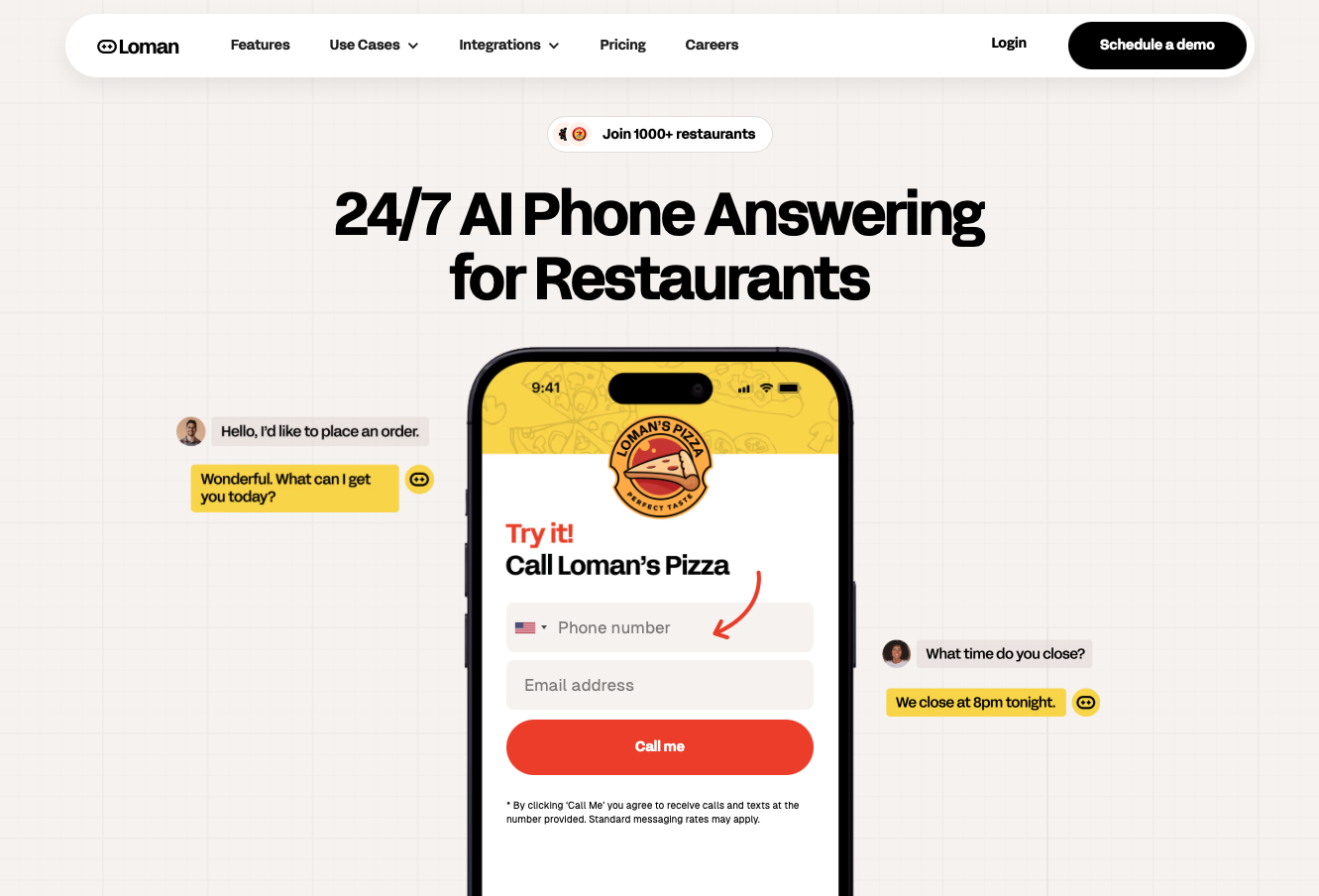
Loman is built for that exact scenario. It answers every call 24/7, takes pickup and delivery orders, books reservations, and handles menu or allergen questions. It also processes payments during the call, so nothing gets dropped.
It connects directly to Toast, Square, Clover, and Aloha, sending orders straight into your system. It can handle unlimited calls at once, speak multiple languages, and suggest add-ons to increase ticket size.
Restaurants using Loman report up to 22% higher revenue and 17% lower labor costs, with AI phone assistants freeing up staff and most going live in under 24 hours.
NICE CXone is built for enterprise teams needing deep customization and workforce tools, while Nextiva focuses on simplicity with bundled communication features for mid-sized teams.
Both NICE CXone and Nextiva route calls and manage queues, but neither understands menu modifications, allergen requests, or delivery windows, and they don't connect natively to restaurant POS systems like Toast, Square, or Clover without custom development work.
NICE CXone deployments take weeks to months depending on routing complexity, AI model training, and data migration needs. Nextiva reduces time-to-value to days with guided onboarding wizards and pre-configured templates that let admins activate IVR menus without scripting.
The Nice CXone vs. Nextiva decision comes down to what your calls actually look like day to day. Both handle routing and queues, but restaurants deal with rush-hour spikes, order details, and customers who want to pay on the spot. That’s where something like Loman fits in, giving you a way to answer every call, take orders, and process payments without adding more pressure on staff. If you want to see how that works in practice, you can check out a restaurant AI phone system built for real service hours.
Enter your information in the form to receive a call from Loman and place an order like a customer would!

